


Wayfinding - Beyond Brainstorming
- Apr 22, 2018
- 3 min read

An effective signage is the one that is never noticed. We come across different types of signages everyday, in airports, on motorways, hospitals, the list goes on an on. The concept of signages barely cross our mind when it works well, It is just something that is there, effectively brainstormed, conceptualized, designed and redesigned to its epitome.
Most people, if asked can only remember the signs that have failed them, but the truth is that the wayfinding system had been the best than it has been at any other point in history.
As long as people have lived in a settled community, there has been a need for an effective wayfinding system. As cities grew larger and humans more mobile a sophisticated wayfinding system developed. Although there has been no evidence of various wayfinding systems of the past, the wayfinding system does not only stick to the graphic interpretation of routes itself.
History
Even before settling in communities the wanderers and the nomad, the people who explored the landscapes through the ocean used the star systems and the constellations to navigate. So the concept has been prevalent into the society far before anybody knew.
A major milestone in the history of wayfinding occured in Rome. The roman empire first created the concept of the paved streets. And along the 60,000 miles of streets various milestones were placed t indicate the distance to Rome, which lead to the origination of the age-old idiom ‘All Roads lead to Rome’. Since then the wayfinding system has been on a path of development across all ages. After the fall of the mighty Roman empire and the onset of dark ages, the city was left to develop with new streets and buildings popping up among the ancient ruins.
After the industrial revolution and the development of the motor industry the world found it needed traffic engineers, and it was these people who were the first to think about the development of a proper sign system.
The 1970s saw the first signs of revolution in urban signages and gave birth to the Society of Environmental Graphic design (SEGD) and the term ‘Wayfinding’ was given to the field.
There are four major types of sign systems that have been developed

Information signs
Directional Signs
Identification signs
Warning Signs
How to Effectively Develop a Wayfinding system
Wayfinding has the function to inform people of the surroundings in the (unfamiliar) build environment, it is important to show information at strategic points to guide people into the right directions. Complex structures in the build environment are interpreted and stored by the human memory. Distances, locations and time may be remembered differently than as they appear to be in reality.
An effective wayfinding system is based on human behavior and consists of the following characteristics:
Do not Make them Think
Show Only What is Needed
Remove Access Information (Schiffner,2017)
How Does Wayfinding Work
How do people navigate in a space, recognize or understand one place easier than another? When creating a wayfinding scheme the following characteristics influences the way we interpreted the build environment.
Landmarks
Orientation
Navigation

Developing a New sign system
After researching and studying about the concepts of sign system it was evident to develop a wayfinding system on our own. The place chosen for this process was the National Institute of Fashion Design, New Delhi.
While roaming through the campus we found out the the college already had a sign system, but it was not user friendly and was hard to communicate with. So to begin with, floor plans and architectural layouts were pulled out and researched. All the major landmarks were considered as to which people would have an ease to communicate and relate with.

We live in the age of technology and the idea of linking the entire system with an app that also juggled augmented reality was considered.
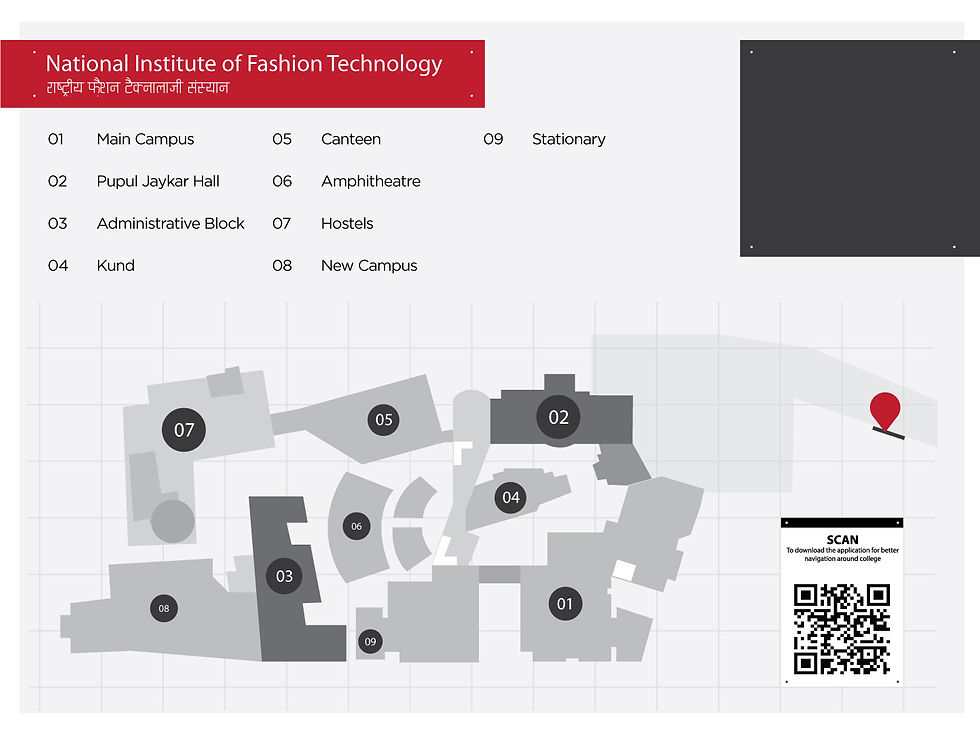

What was found out in the entire process is that the signs needs to be straight forward designed and in a consistent order to way finding scheme, always use the same order of displaying the information. Remember to make various types and styles of design before finalizing on a concept. Trying out various designs gives you an idea as to how people will interact with your designs.


Comments